
Tomatoes are actually fruits and not vegetables, like all fruits they produce abundant sugars. For the first 4 – 6 weeks of a Tomato plants life, all of the sugar it produces is directed towards new leaf growth. During this stage, tomato plants grow extremely rapidly doubling in size about every 2 weeks.
When the plants produces more sugar than existing foliage can use, the plant makes new branches and produces flowers. In the ensuing several weeks, the tomato plant changes dramatically.
The Tomato Plant should be supported at this time, if left unsupported, the weight of growing tomatoes and foliage forces the plant to the ground.
Left alone, a healthy indeterminate tomato plant can cover a 4- by 4-foot area . By season’s end, having picked up multiple soil born pathogens it will be an impenetrable, diseased mess.
Prune Tomato Plants for structure and health
The two key benefits of Pruning and supporting Tomato plants are
1. Maximizing the efficiency of photosynthesis.
2. Minimizing the risk of Disease.
The end result of both these tasks being an abundant and timely harvest of tomatoes for your salads, sauces and etc. Ensuring that the leaves have ample room and are kept off the ground is the first objective.
When a tomato plant has dense unpruned growth or when it lies on the ground many of its leaves are shaded, lacking sunlight essential for photosynthesis to take place. This reduces the amount of sugar they can produce.
A properly pruned and supported tomato plant exposes the maximum surface area of its leaves to the sun, and will produce larger healthier tomatoes several weeks earlier than a prostrate one. Sugar produced by a properly pruned and supported tomato plant is directed to the developing fruit, not unnecessary foliage.
The leaves of a properly maintained plant dry off quicker, hence bacterial and fungal pathogens have less opportunity to spread. Soil is not as likely to splash up onto straight well supported upright plants.
Basically, upright tomato plants have fewer problems with leaf spots and fruit rots.
I like to keep my tomatoes free of side stems below the first cluster of fruit . Trained to one vine and left free-standing, tomato plants develop strong main stems. Trim all suckers and don’t tie plants to their supports until the first flowers appear.
Indeterminate tomato plants grow continuously, limited only by the season. Indeterminates produce foliage and fruit as long as they can survive. Indeterminate tomatoes can have several stems, four is the most for optimal results. The more stems, the less tomatoes. Less stems will produce fewer but larger tomatoes.
For a multi-stemmed plant, let a second stem grow from the first node above the first fruit. Allow a third stem to develop from the second node above the first set fruit, and so forth. Keeping the branching as close to the first fruit as possible means those side stems will be vigorous but will not overpower the main stem.
Determinate tomatoes need little or no pruning. Remove suckers below the first flower cluster only. Any pruning above the first flower cluster on determinate tomatoes and you’ll be throwing away potential fruit.
Advantages of pruning
1. Allows for better air circulation around plants, keeping them healthier
2. Helps to prevent the spread of disease through fungal & soil born pathogens
3. Allows more plants to grow in a minimal area
4. Results in larger healthier tomatoes
5. Makes it easier to keep plant properly supported
Methods of Pruning Tomato Plants
There’s allot of contradictory information regarding the pruning of tomato plants, everybody seems to have their own methods and opinions. Most of these methods, {most not all} are perfectly valid. There really is no right way or wrong way, just the ways that work.
The practice of ‘pinching back the first shoot to encourage plant growth’ does not apply to a tomato plant. The seedlings are too delicate, so one should wait for it to have at least two to three ‘suckers’ growing from its main stem. The suckers are side shoots that sprout between the main stems of a tomato plant, and go on to become stems, with their own sprouts
Simple Pruning
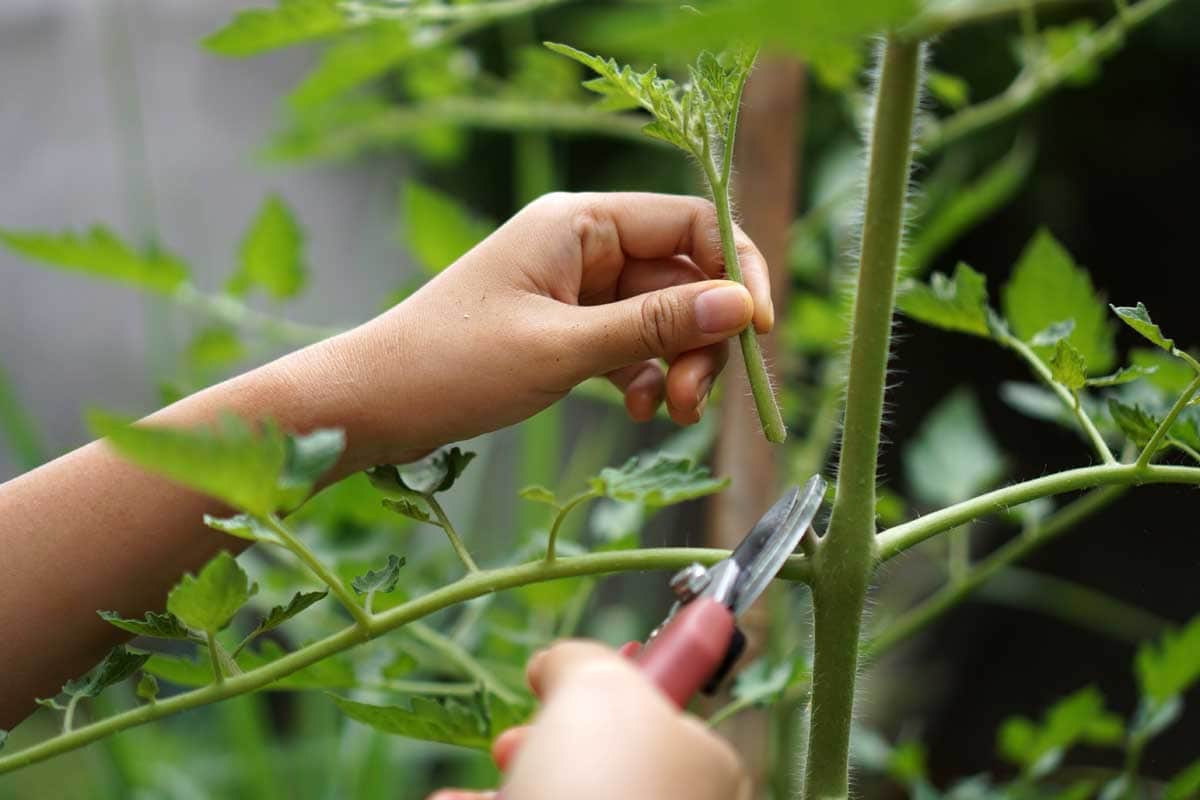
For a sucker that shant become a stem. The simplest method is to “nip it in the bud” that is pinch it off entirely while it is still small and succulent, without the significant woody fibrous strings that a mature tomato plant has.
Grab the base gently between your thumb and index finger and bend it back and forth till it breaks off. The sucker should snap , producing only a small wound that will heal quickly. Avoid cutting it with a blade, because the resulting nub and wound can easily be infected. If you wait till a sucker becomes too tough and fibrous to snap off, you’ll have to use a blade. Try to make a clean cut, all the way through, should you fail to make a clean cut you may rip a fibrous string down the stem {much like celery} causing a much larger wound than is necessary.
French Pruning
French-pruning tomatoes is a method used to get high volume yields of quality tomatoes in a limited area. The method involves pruning tomato vines to encourage them to set fruit close to the main stem. French pruning tomatoes works best on indeterminate, medium-size fruit types. Plants are placed about 2 feet apart and each main stem must be supported with a stake. All lower, lateral branches are pruned out as the plant grows leaving a leafy canopy of all the plants together. When plants reach full height, pinch back the growing tip to encourage a thicker canopy.
Missouri pruning
In Missouri pruning, you should pinch out the uppermost tip of the sucker, allowing a leaf or two to remain. This is to ensure that the plant has adequate foliage area for photosynthesis as well as to protect newly developing tomatoes from sun-scald. However, new suckers continuously develop along the side stems, adding to your future pruning.
Missouri pruning is sometimes used when pruning has been neglected for too long, and you’re dealing with large suckers, it’s better to pinch off just the tip than to cut off the whole sucker close to the main stem. Removing just the growing tip is less of a shock for the plant and once again reduces the risk risk of parasitic infection.