

Eggplants can be a tad demanding, they have their needs – consistent moisture, lush soil and nutrients, sunlight, warmth, and not too much wind.
When properly maintained, and with a dose of good luck, they will produce the fruits for our eggplant parmigiana and assorted dishes in abundance.
This article contains common symptoms and their probable causes and treatments.
One of the most common problems encountered when growing eggplant is defoliation by insects – they eat the leaves and at times the eggplant itself.
Different pests leave varying tell-tale signs, and strike at different times during the growing season
Related: Red Eggplant Varieties
Eggplant Insect Pests
1. Flea Beetles

Small round holes in foliage early in the season, more prevalent on lower leaves. Check for Flea Beetles, tiny black beetles that feed on leaves and are common on eggplant. They not only attack eggplant, but also seedlings of tomatoes, potatoes, peppers, radishes, and corn
They generally jump when disturbed. Handpicking beetles in mild infestations is feasible. Keep the garden free of plant debris. Cultivate the soil deeply to destroy any larvae in early spring.
Cedarcide is an effective deterrent of flea Beetles and a large array of other insect pests.
2. Colorado Potato Beetle

Leaves are stripped bare – basically skeletonized – Probable culprit is the Colorado Potato Beetle, a black and yellow-striped beetle that feasts on eggplant, potato, tomato, and related crops.
Bacillius thuringiensis is effective against the Colorado Potato Beetle. It will control early stages of the Colorado potato beetle and larvae.
Handpicking in mild infestations is feasible, however, this pest has multiple generations annually – so while you’re handpicking there are more larvae developing beneath the soil surface. Cultivate the soil deeply to destroy any larvae, Keep the garden free of plant debris.
3. Tomato Hornworm

Large holes and chunks gnawed in fruits and leaves
The Tomato Hornworm is a destructive pest of eggplant as well as tomato, potato, and pepper plants. They consume leaves and stems as well as chewing pieces from the fruit itself.
Handpicking is feasible, proper garden sanitation is essential to controlling any pest populations.
Spray with Sevin or pyrethrum .
Other insects could also be at blame if you are unable to locate any of the worms. Blister beetles are also known to chow down on eggplant and related crops.
4. Thrips

White spots on Eggplants, distorted leaf tips.
Look for Thrips. They are yellow, brown to black very small flying insects with fringed wings. They scrape and scar plant tissue as they feed. Proper garden sanitation, such as Keeping the garden weed-free is a good preventative measure. Spray with insecticidal soap or dust with diatomaceous earth.
5. Aphids

Leaves are somewhat curled, deformed, and-or discolored. Plant growth is stunted.
Look for a sap-sucking insect. Aphids are the most common. Aphids are basically planted lice. They are Yellowish-pink to pale green, soft-bodied, oval~pear-shaped insects and are commonly found on nearly all varieties of plants.
Hand picking is not feasible as they are too small and numerous
Hot Pepper Wax helps to repel aphids from your plants, but needs to be frequently re-applied.
Neem is the safest and surest eco-friendly mode of Aphid control and can be used in conjunction with predatory strategies such as Lady Bugs.
6. Spider Mites
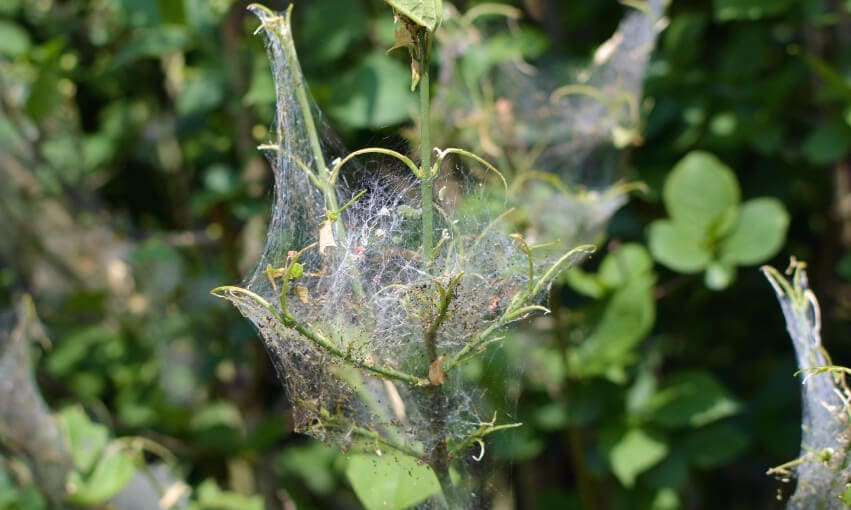
Fine Webbing on under sides of leaves. Discolored shoots – pale yellow to white.
Spider Mites are another sap sucking insect.
Spraying with water will rid the plant of them -temporarily- use insecticidal soap or rotenone for a more permanent control.
7. Whiteflies

Leaves wilt, discolor to a yellowing followed by browning.
Whiteflies are another minute insect that will infest eggplant. They flutter in swarms, a cloud, when disturbed, and are not difficult to detect. Insecticidal soap will help against whiteflies. Trap whiteflies with Tanglefoot spread on a yellow card or yellow sticky traps.
8. Leaf Hopper
Leaves will appear limp, scorched and wilted when Leafhoppers are feeding.
They are not a frequent pest of eggplant, just an occasional one.
See Leaf Hopper Identification and Control.
Dust plants lightly with diatomaceous earth as a deterrent, if they are a chronic problem.
9. Spittle Bugs
Foamy white froth on plant stems. Spittle Bugs are the culprit. You’ll find them beneath the foam. They are not very damaging and I wouldn’t recommend using an insecticide for them alone.
10. Pepper Maggots
Small, irregular to oval-shaped holes along the fruit surface are signs that pepper maggots may be feasting inside. Pepper Maggots are a common pest of Eggplant and related crops.
To reduce populations, sanitation and crop rotation is helpful. Pick up any fallen peppers and destroy them. Destroy any horse-nettles (an alternate host) in the vicinity.
Neem will help control populations as well.
11. Root Knot Nematodes

Knotted plant roots, Galls on roots. Plants wilt readily in dry weather and become stunted.
Root knot nematodes are the likely culprit.
They are minute translucent worms that inject toxins into plant roots.
There are some resistant varieties – See Eggplant Varieties.
Fish emulsion is believed to help counter nematode toxins, although this has not been scientifically proven. Inter-plant with marigolds. Once infested Predator Nematodes will control the populations of parasitic ones.
12. Cutworms
Seedlings are sheared off at the soil level.
Cutworms are the culprit. They are gray to brown nocturnal grubs that feed at night. Handpicking grubs from the soil around plant bases is helpful, however, they hide in the soil by day and are not easily spotted. Keep the garden free of plant debris.
Bt bacillus thuringiensis
Eggplant Diseases
13. Physiological Leaf Roll
Leaves droop and roll downward without stunted growth or yellowing.
This is known as Physiological leaf roll, it is not caused by fungus or bacteria, or even insects. It is generally a reaction to climatic conditions. Keep the plants evenly watered. If the issue persists as the weather improves – you may have a nutrient deficiency.
See – Plant Nutrient Deficiencies
14. Blossom End Rot
Sunken rot spots, frequently moist and waterlogged lesions. They sometimes blacken and attract fungal/mold growth. Appears on the blossom end of eggplants. It initially occurs as a slight discoloration at the blossom end.
Blossom End Rot is caused by temporary insufficiency of water and calcium. The soil may have a calcium imbalance inhibiting the uptake of water. Adding limestone can help if the soil if the pH is below 6.0. It may also occur under high temperatures when the eggplants are rapidly growing. Recommended treatment Blossom-End Rot
15. Soil Rot
A soft brown rot develops, usually on the sides of fruits touching the ground, or where the soil is splashed onto them.
Soil rot, is caused by the a soil-borne fungus and generally occurs during rainy periods.
The spots are sunken, large, and may have a closely-spaced bulls-eye pattern. Sometimes the eggplant cracks open. Staking will reduce soil rot by keeping fruit away from the ground.
16. Phytophthora Blight
Sudden wilting and death occur as the eggplants reach the fruiting stage Often a number of plants in a row or in a roughly circular pattern will show symptoms at the same time.
Phytophthora blight attacks the roots, stems, leaves, and fruit. An unsuspecting grower will first encounter the disease at mid-season.
Avoid water-logged root zones – Grow eggplant in well drained fields. Planting on raised beds will increase soil drainage. Water management is of primary importance for controlling Phytophthora blight. Rotate infested fields with other non-host crops for several years
Agri-Fos and Actinovate are registered for use by home gardeners against Phytophthora blight
17. Verticillium Wilt
General or blotchy yellowing of the lower leaves and a wilting of youngest shoots in direct sunlight. At first, the wilted shoots may recover overnight. The leaf veins turn brown, followed by shoots browning and lower leaf drop. Leaves higher up on the plant turn dull green in color and the edges curl upwards.
Eggplant Plants are stunted and defoliated with only the growing tips remaining green. The fruits are small and may sunscald. The branches tend to be less erect than those of healthy eggplants, giving the plants a prostrate appearance. When the stem is cut open, the water conductive plant tissues may be brownish near the soil line.
Verticillium Wilt is the likely culprit
Sorry to tell you this – but the prognosis, diagnosis and determination is fatal – your plant is gonna die !
Verticillium Wilt can’t be cured once it enters the plant. Remove and destroy infected plants. The disease remains in the soil long after you remove the plant
Rotate crops and avoid planting in soil previously planted with related or other susceptible crops.